
Our picks
Best overall
1. Logitech ERGO K860 Split Ergonomic Keyboard (920-009166)
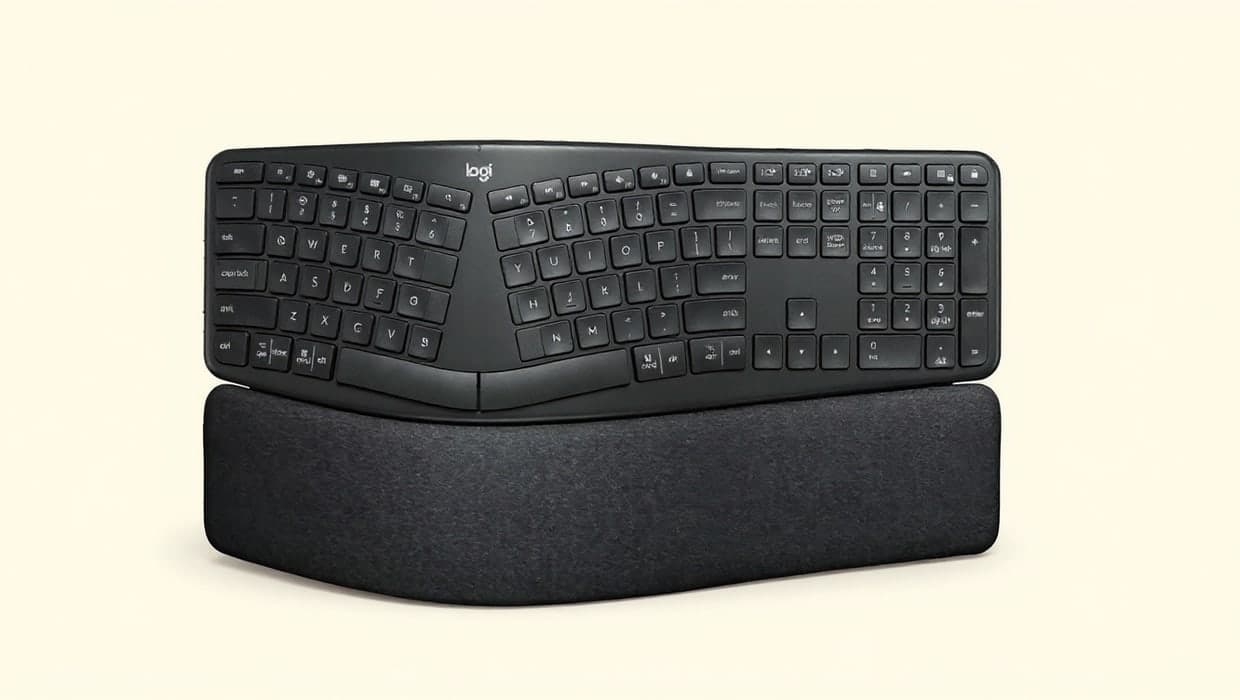
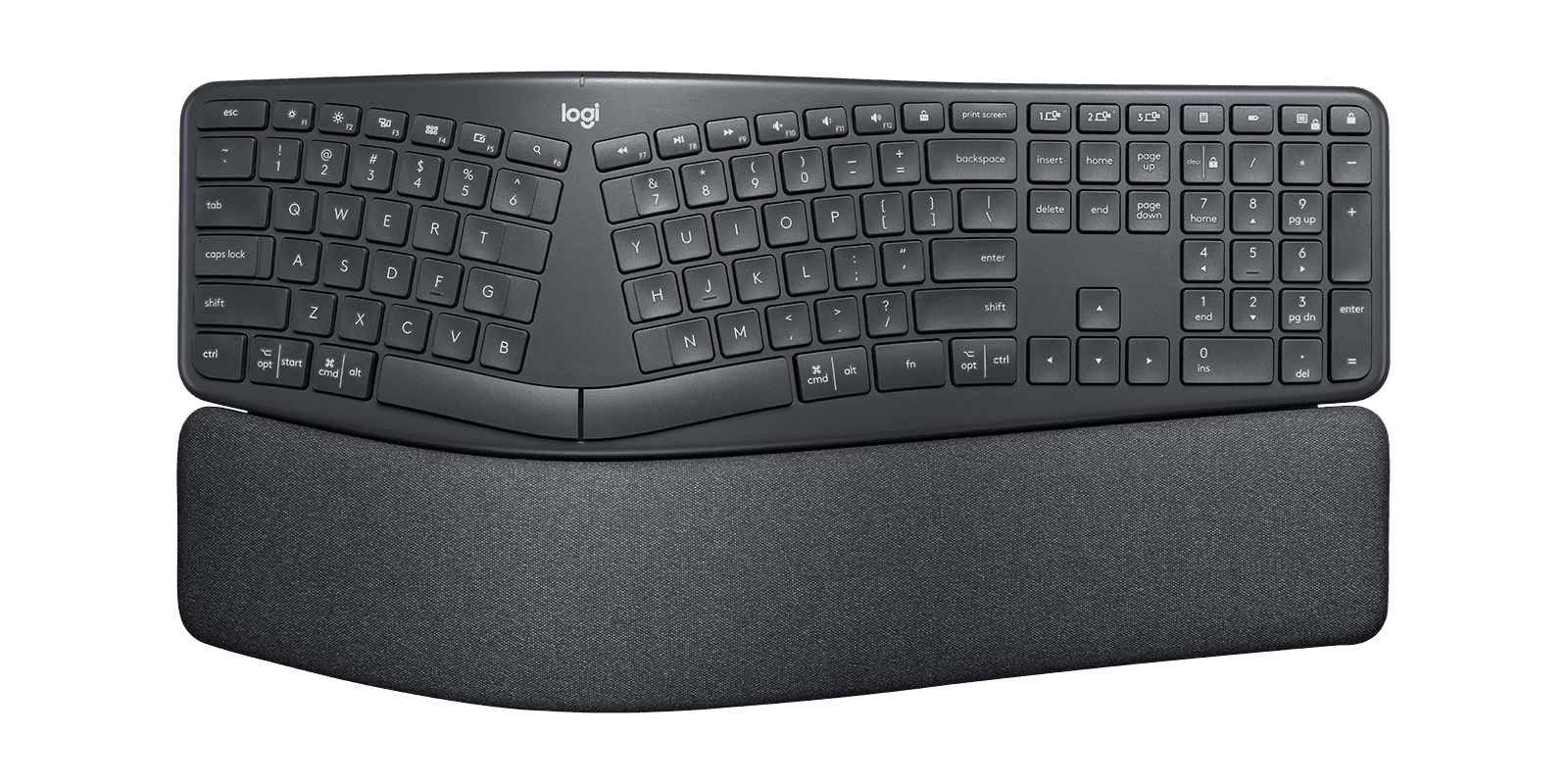
The Logitech ERGO K860 is the easiest step up from a flat keyboard for most home offices. It is a full-size, one-piece keyboard with a curved, split keyframe, a number pad and a pillowed wrist rest built into the frame. Tilt legs set the front edge higher at 0°, -4° or -7°. It connects by Bluetooth Low Energy or Logitech’s Unifying USB receiver, switches between up to three devices, and runs for up to 24 months on two AAA batteries.
Pros
- Curved split layout with a full number pad
- Three negative-tilt settings: 0°, -4° and -7°
- Up to 24 months on 2 x AAA; pairs with 3 devices
Cons
- Wrist rest is fixed and can’t be removed
- No backlighting, and not spill-resistant
Also at: Micro Center, Best Buy
Best compact wave keyboard
2. Logitech Wave Keys Wireless Ergonomic Keyboard, Sand (920-013925)
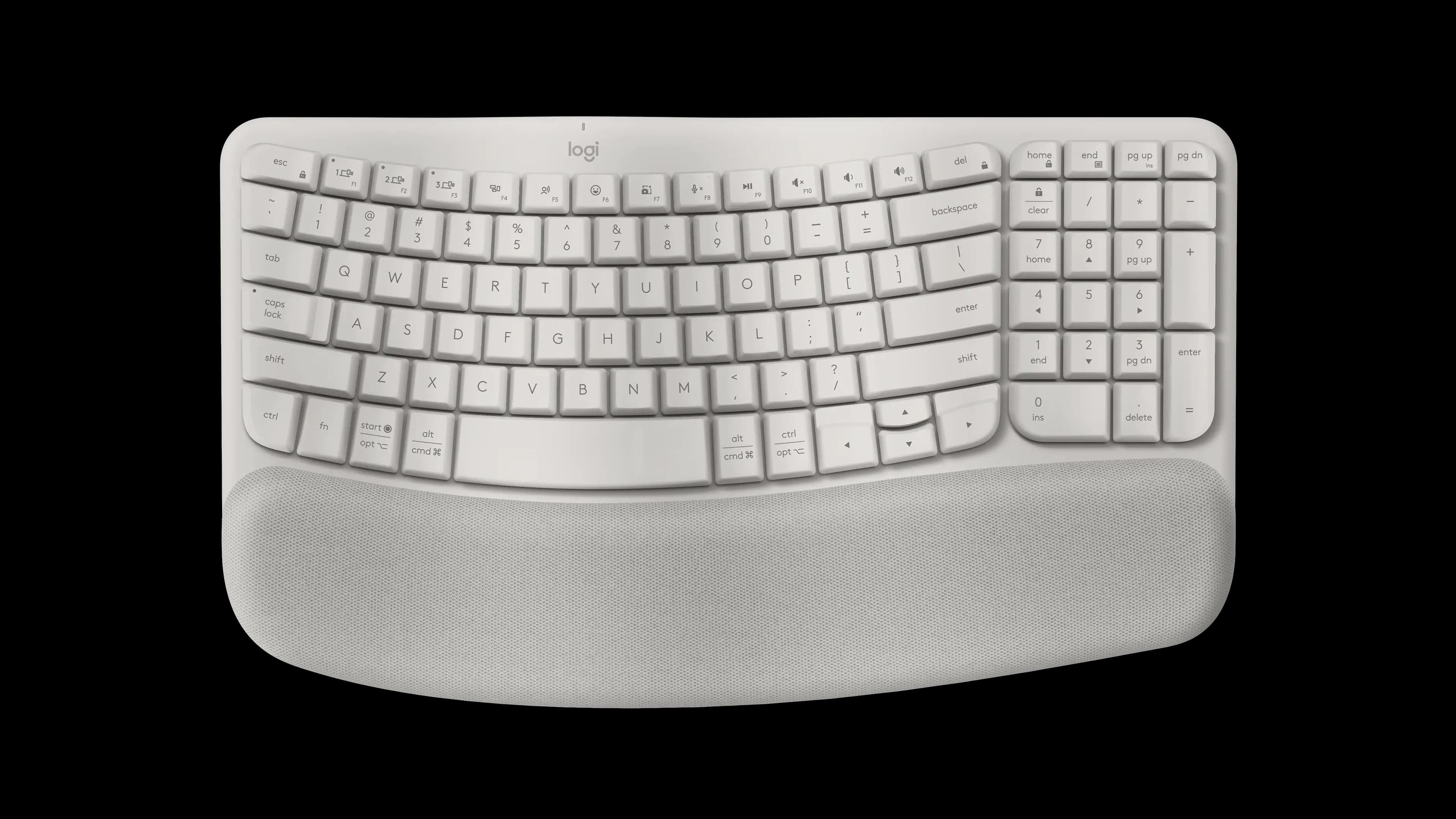
Logitech’s Wave Keys packs a number pad into a compact, wave-shaped keyboard 14.8 inches long, with a cushioned palm rest made from three layers of memory foam. Unlike the K860, its tilt legs are a conventional +4 degrees rather than negative. It connects by Bluetooth Low Energy or the included Logi Bolt receiver, switches between three devices, and Logitech rates it at up to 36 months on two AAA batteries.
Pros
- Compact wave layout that still has a number pad
- Up to 36 months on 2 x AAA
- Dual-printed Windows and Mac keys
Cons
- Palm rest is permanently attached
- Only a +4° tilt; no negative-tilt option
Also at: Micro Center, Best Buy
Best fully split keyboard
3. Kinesis Freestyle2 Blue for PC (KB800PB-BT)
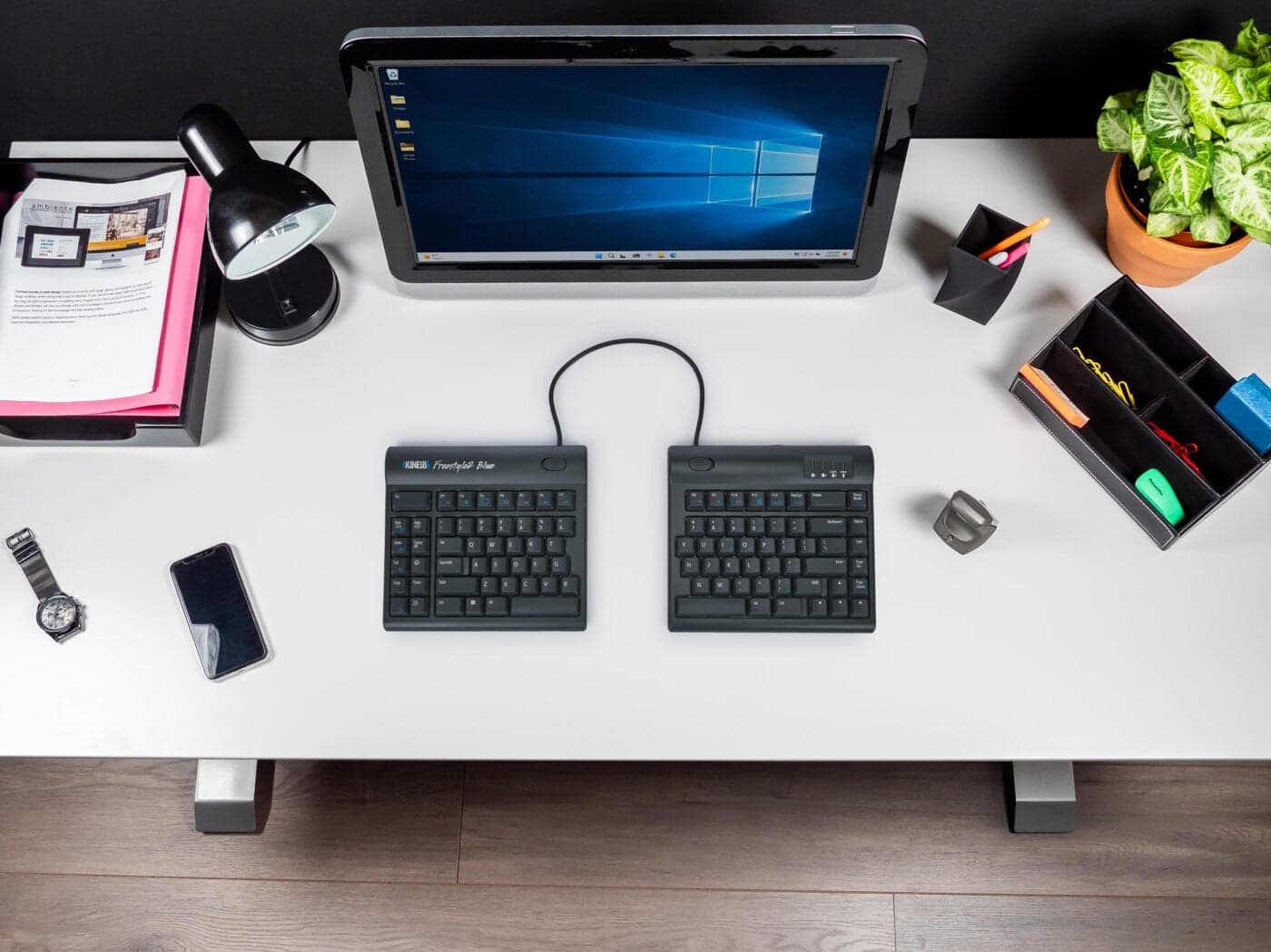
The Kinesis Freestyle2 Blue splits into two separate halves joined by a flexible tether, and removing the tether lets you set them up to 9 inches apart. It sits flat and low (0.875 inches at its highest point), with membrane keys that need 45 grams of force. Bluetooth 5.1 pairs it with up to three devices, and the rechargeable battery is rated at more than 300 hours of typing. Palm supports and tenting (5°, 10° or 15°) are optional add-on kits, not included.
Pros
- Two separate halves, up to 9 inches apart
- Rechargeable; over 300 hours of typing per charge
- Low, flat profile at 0.875 inches
Cons
- Palm supports and tenting cost extra as add-on kits
- Bluetooth only; hot keys don’t work on a Mac
Also at: Best Buy
Best mechanical ergonomic keyboard
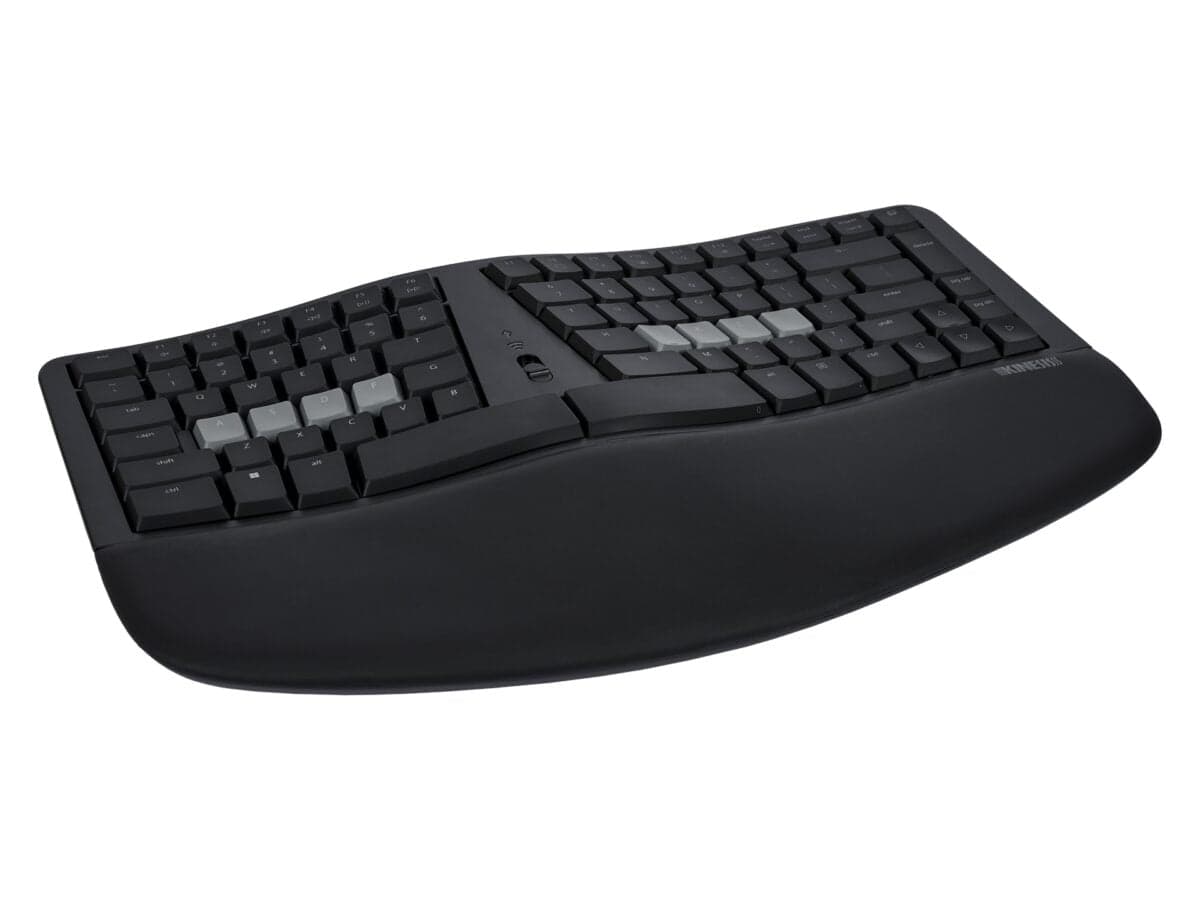
4. Kinesis mWave Mechanical Keyboard for PC, Tactile (KB150P-TAC)
The Kinesis mWave takes the familiar wave shape and adds mechanical switches: this version uses tactile Gateron Low Profile Brown switches (55 grams, 3.0mm travel). It has a fixed split, built-in tenting and a washable palm support, and the box includes three magnetic feet for a negative tilt. It works wired over USB or wirelessly over Bluetooth with two devices, and the key layout can be reprogrammed in Kinesis’s browser-based Clique editor. Its 85-key layout embeds the keypad rather than adding a separate number pad.
Pros
- Low-profile tactile mechanical switches
- Built-in tenting plus magnetic negative-tilt feet
- Wired or Bluetooth, and programmable in a browser
Cons
- Backlighting works only when plugged in over USB
- Best Buy’s listing is sold by a marketplace seller
Also at: Best Buy
Best rechargeable one-piece
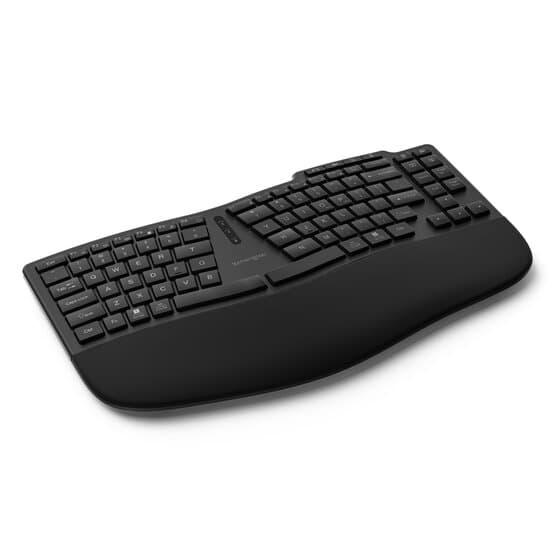
5. Kensington Pro Fit Ergo KB675 EQ TKL Rechargeable Keyboard (K75491US)
Kensington’s Pro Fit Ergo KB675 is a curved, tenkeyless (TKL) keyboard with a built-in wrist pad, front legs and a 500mAh battery that charges over USB-C. It connects to two devices over Bluetooth 5.4 and a third through its 2.4GHz USB receiver, and adds dedicated video-conferencing keys. Kensington says it is designed for small to average-sized hands, so people with large hands may prefer the K860.
Pros
- Rechargeable over USB-C; no disposable batteries
- Three connections: two Bluetooth 5.4 plus a USB receiver
- Video-conferencing keys and a 3-year limited warranty
Cons
- Sized for small to average hands
- No number pad (tenkeyless)
Also at: Best Buy
The best ergonomic keyboard for most people working from home is the Logitech ERGO K860: a full-size, curved, split keyboard with a built-in wrist rest and adjustable negative tilt. If you want something smaller, the Logitech Wave Keys keeps the number pad in a compact wave shape. For a keyboard you can pull fully apart, look at the Kinesis Freestyle2 Blue; for mechanical switches, the Kinesis mWave; and for a rechargeable one-piece, the Kensington Pro Fit Ergo KB675.
"Ergonomic" covers very different designs, so this guide explains what each one is and which details to compare.
The short version
- Best overall: Logitech ERGO K860. Curved split layout, full number pad, fixed wrist rest, 0°/-4°/-7° tilt legs.
- Best compact wave keyboard: Logitech Wave Keys. Wave-shaped, number pad included, memory-foam palm rest, up to 36 months on AAA batteries.
- Best fully split keyboard: Kinesis Freestyle2 Blue. Two halves up to 9 inches apart, Bluetooth, rechargeable.
- Best mechanical ergonomic keyboard: Kinesis mWave. Low-profile tactile switches, built-in tenting, wired or Bluetooth.
- Best rechargeable one-piece: Kensington Pro Fit Ergo KB675. Curved tenkeyless layout, USB-C charging, three connections.
How they compare
Keyboard | Design | Wrist rest | Tilt and tenting | Connection | Power |
|---|---|---|---|---|---|
Logitech ERGO K860 | Curved split, one piece, full size | Built in, fixed | Legs: 0°, -4°, -7° | Bluetooth LE or Unifying receiver, 3 devices | 2 x AAA, up to 24 months |
Logitech Wave Keys | Wave shape, compact with number pad | Built in, 3-layer memory foam | Legs: +4° | Bluetooth LE or Logi Bolt receiver, 3 devices | 2 x AAA, up to 36 months |
Kinesis Freestyle2 Blue | Two separate halves, up to 9 in apart | Optional add-on | Flat; 5°/10°/15° tenting with add-on kits | Bluetooth 5.1, 3 devices | Rechargeable, 300+ hours of typing |
Kinesis mWave | Fixed split wave, 85 keys, mechanical | Built in, washable | Built-in tenting; magnetic negative-tilt feet | USB cable or Bluetooth, 2 devices | 2 x AA (included) |
Kensington KB675 | Curved, tenkeyless (TKL) | Built in | Front legs | Bluetooth 5.4 (x2) + 2.4GHz receiver, 3 devices | 500mAh rechargeable, USB-C |
Four of the five are one-piece keyboards; only the Freestyle2 Blue comes apart. The mWave is the mechanical pick.
The main ergonomic keyboard designs
Curved and wave one-piece keyboards
The K860, Wave Keys, mWave and KB675 all keep the keys in one body but angle or curve the rows so each hand sits a little apart from the other. They look closer to a normal keyboard than a fully split design. The difference between them is how far they go: the K860 has a clear split down the middle with a curved frame, while the Wave Keys uses a gentler wave across the rows.
Fully split keyboards
A fully split keyboard, like the Freestyle2 Blue, is two separate halves. You choose how far apart they sit and at what angle, from almost together to 9 inches apart on the Freestyle2 Blue. The trade-off is setup: you have to find a spacing and angle you like.
Mechanical ergonomic keyboards
The Freestyle2 Blue uses membrane (rubber dome) keys. A mechanical ergonomic keyboard such as the mWave uses an individual switch under each key instead. Kinesis sells it with tactile brown switches (a small bump you feel as the key registers, 55 grams) or quiet red linear switches (smooth, 45 grams); the red version has a separate part number, KB150P-LIN.
What to compare before you buy
Tilt and tenting
Most keyboards are higher at the back than at the front. Two other options appear in this guide:
- Negative tilt raises the front edge instead. The K860's legs give 0°, -4° or -7°, and the mWave comes with magnetic feet that do the same. Kinesis recommends using a keyboard tray with the mWave's negative-tilt feet.
- Tenting raises the middle of the keyboard so the two halves slope down to the sides, like a tent. The mWave has it built in; the Freestyle2 Blue adds it with optional kits set at 5°, 10° or 15°.
The Wave Keys goes the conventional way, with +4° tilt legs.
Wrist rests
The K860, Wave Keys, mWave and KB675 all have a wrist or palm rest built in. On both Logitech models it is permanently attached, so if you'd rather use your own, pick the Freestyle2 Blue, where palm supports are an optional extra. The mWave's palm support is washable.
Number pad or tenkeyless
If you enter numbers all day, the K860 and Wave Keys both include a full number pad. The KB675 is tenkeyless (no number pad), and the mWave uses an 85-key layout with an embedded keypad, which keeps it narrower so your mouse can sit closer.
Connections and batteries
All five are wireless. The Logitech models and the KB675 come with a USB receiver as well as Bluetooth; the Freestyle2 Blue and mWave use Bluetooth only, with no dongle, so your computer needs Bluetooth (built in or through an adapter). The mWave can also run over its USB cable, which is the only way to turn on its white backlighting.
On power, the K860 and Wave Keys run on AAA batteries for up to 24 and 36 months respectively. The Freestyle2 Blue and KB675 are rechargeable; Kinesis rates the Freestyle2 Blue at more than 300 hours of typing per charge. If you split your day between a laptop, a tablet and a phone, all but the mWave switch between three devices; the mWave pairs with two over Bluetooth.
Mac or Windows
The K860 and Wave Keys have dual-printed Windows and Mac keys. The Freestyle2 Blue for PC works with a Mac only in basic form (its hot keys don't work), and both Kinesis keyboards are also sold in separate Mac versions. The KB675 lists Windows, macOS and ChromeOS. If you are choosing a new laptop to go with it, see our guide to laptops for working from home.
Which is the best ergonomic keyboard for you?
Start with how different from a normal keyboard you want it to feel, then check the details that matter for your desk.
- You want the least change from a standard keyboard: the Logitech Wave Keys. It keeps a number pad in a compact body, with a gentle wave and a padded palm rest.
- You want a clear split, but in one piece: the Logitech ERGO K860. Its split is more pronounced than the Wave Keys, and it is the only pick with adjustable negative tilt legs built in.
- You want to set the width yourself: the Kinesis Freestyle2 Blue. The two halves can sit together or up to 9 inches apart, and you can add tenting later with an optional kit.
- You want mechanical keys: the Kinesis mWave, with low-profile tactile or quiet linear switches, built-in tenting and a wired option.
- You want no disposable batteries and a narrower board: the Kensington KB675, which charges over USB-C and drops the number pad, as long as your hands are small to average in size.
Setting up your desk around the keyboard
An ergonomic keyboard is one part of the desk. With a laptop, a separate keyboard frees you to put the laptop on a stand or connect an external monitor. If you are adding a screen at the same time, our home-office monitor guide covers size and resolution.
How we chose
These recommendations are research-based: we have not tested these products ourselves. Every figure quoted here comes from the manufacturer’s or a retailer’s own published spec sheet (linked under Sources), not from a shopping listing title. We started from real ergonomic keyboards listed by major US retailers, left out gaming models, and picked one strong option for each common design rather than five variations of one. We also looked at:
- Design range. A curved one-piece, a wave, a fully split, a mechanical and a rechargeable tenkeyless keyboard.
- Adjustability. Tilt legs, tenting and whether the wrist rest is fixed or optional.
- Everyday practicality. Wireless connections, number of paired devices, battery type and life, and Mac or Windows layout.
- Where you can buy it. We link to the retailers we could confirm list the exact model; we don't compare their prices. Some Best Buy listings here are sold by marketplace sellers, which we note in the picks.
FAQs
Is a split keyboard better than a curved one-piece keyboard?
Neither is better for everyone. A fully split keyboard like the Kinesis Freestyle2 Blue lets you choose the spacing and angle of each half, while a curved one-piece like the Logitech ERGO K860 is closer to a normal keyboard and needs no setup.
What is negative tilt on a keyboard?
Negative tilt means the front edge of the keyboard sits higher than the back, the reverse of most keyboards. The Logitech ERGO K860 has legs for 0°, -4° and -7°, and the Kinesis mWave includes magnetic feet for a negative tilt.
Are there mechanical ergonomic keyboards?
Yes. The Kinesis mWave in this guide uses low-profile Gateron mechanical switches, sold in a tactile brown or a quiet linear red version. It also has built-in tenting and a palm support.
Do these ergonomic keyboards work with a Mac?
The Logitech ERGO K860 and Wave Keys have dual-printed Windows and Mac keys, and the Kensington KB675 lists macOS support. The Kinesis Freestyle2 Blue and mWave for PC use Windows layouts, and Kinesis sells separate Mac versions of both.
Do I need a USB receiver for a wireless ergonomic keyboard?
Not always. The Logitech models and the Kensington KB675 include a USB receiver and also work over Bluetooth. The Kinesis Freestyle2 Blue and mWave connect by Bluetooth only, with no receiver, so your computer needs built-in Bluetooth (the mWave can also use its USB cable).
Sources
- Logitech ERGO K860 product page and specifications
- Logitech Wave Keys product page and specifications
- Kinesis Freestyle2 Blue for PC specifications
- Kinesis mWave features and specifications
- Kinesis mWave for PC store page (switch options)
- Kensington Pro Fit Ergo KB675 EQ TKL Rechargeable Keyboard (K75491US) product page